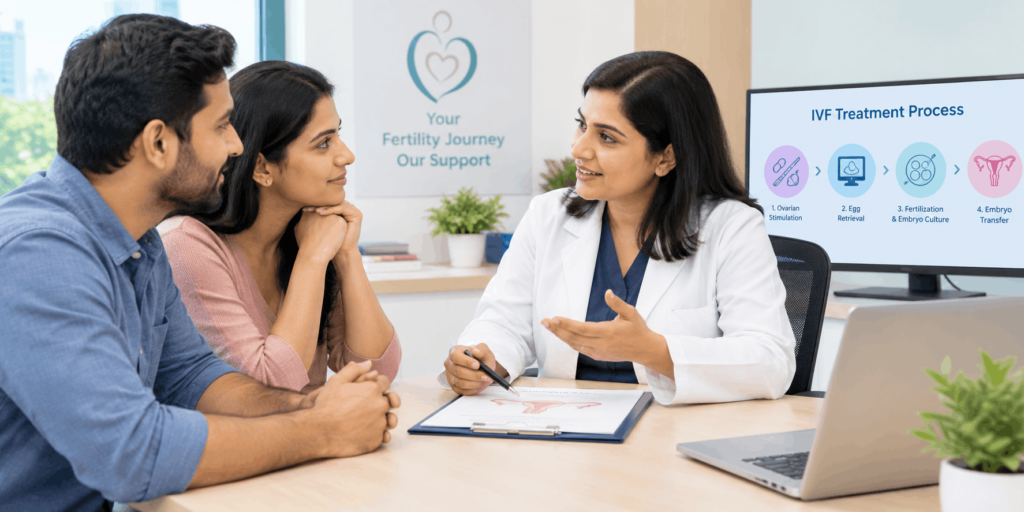
IVF Process Step by Step Guide by Dr. Aarti Parakh
In vitro fertilization (IVF) can seem complicated when you first hear about injections, egg retrieval, fertilization, embryos, and transfer. However, understanding each stage can make the journey easier to follow. IVF is a structured fertility treatment in which eggs and sperm are brought together in a laboratory, embryos are developed under controlled conditions, and a selected embryo may be transferred into the uterus.
This step-by-step guide explains the IVF Treatment in Nashik process, from the initial evaluation through pregnancy testing, along with practical lifestyle considerations during treatment.
What Is IVF?
IVF is an assisted reproductive technology used to help achieve pregnancy when conception does not occur naturally or when certain fertility factors make other treatments less suitable.
In a typical IVF cycle, medications stimulate the ovaries to develop multiple follicles. Mature eggs are then collected and fertilized with sperm in a laboratory. The resulting embryos are monitored for development, and an appropriate embryo may be transferred into the uterus.
The exact protocol varies according to the woman’s age, ovarian reserve, previous fertility treatment, medical history, and other factors.
Step 1: Pre-IVF Evaluation
Before starting an IVF cycle, the fertility team performs a detailed assessment of both partners. This helps determine whether IVF is appropriate and which treatment protocol may be suitable.
Tests for the Woman
Common assessments may include:
- Pelvic ultrasound
- Antral follicle count (AFC)
- AMH testing
- Thyroid testing
- Blood sugar evaluation
- Liver and kidney function tests when indicated
- Other blood tests based on medical history
AMH and AFC can provide information about ovarian reserve and help the doctor plan ovarian stimulation. However, neither test alone can predict whether IVF will result in pregnancy.
Tests for the Male Partner
Semen analysis generally evaluates:
- Sperm concentration
- Sperm motility
- Sperm morphology
- Semen volume
Depending on the findings and medical history, additional investigations may be recommended.
If a health issue or nutritional deficiency is identified before treatment, the doctor may recommend appropriate management before proceeding.
Step 2: Ovarian Stimulation
Once the treatment plan is finalized, ovarian stimulation begins.
Fertility medications are used to encourage the development of multiple follicles rather than allowing only one egg to mature during a natural menstrual cycle.
In many IVF protocols, stimulation begins early in the menstrual cycle and continues for approximately 8–12 days, although the duration varies from person to person.
During this stage, ultrasound monitoring is performed at intervals determined by the fertility team. Blood tests may also be used when appropriate.
The purpose of monitoring is to assess:
- Follicle growth
- Number of developing follicles
- Endometrial development
- Response to medication
- Appropriate timing for egg retrieval
Medication doses may be adjusted according to the response.
Step 3: Trigger Injection
When the developing follicles reach an appropriate stage, the doctor determines the timing of the trigger injection.
The trigger helps complete the final maturation of the eggs and prepares them for retrieval.
Timing is extremely important because egg retrieval is planned at a specific interval after the trigger injection.
Patients should follow the exact timing instructions provided by their fertility team.
Step 4: Egg Retrieval
Egg retrieval, also called oocyte retrieval or ovum pickup, is performed under appropriate sedation or anesthesia.
Using ultrasound guidance, the doctor carefully guides a needle through the vaginal route toward the ovarian follicles. Fluid containing the eggs is aspirated and sent to the embryology laboratory.
The procedure itself is relatively short, although recovery requirements vary.
The embryology team then examines the collected fluid to identify and assess the retrieved eggs.
Step 5: Fertilization and ICSI
After egg retrieval, the eggs are prepared for fertilization.
Depending on the clinical situation, conventional IVF or ICSI (Intracytoplasmic Sperm Injection) may be used.
In ICSI, an embryologist selects an appropriate sperm and injects it directly into a mature egg using specialized laboratory equipment.
ICSI may be recommended in situations such as certain male-factor fertility problems or previous fertilization difficulties. It is not automatically necessary for every IVF patient.
The fertilized eggs are then placed in controlled laboratory conditions for further development.
Step 6: Fertilization Check
The embryology team checks the eggs after fertilization to determine how many have successfully fertilized.
This is an important milestone because not every retrieved egg will necessarily fertilize, and not every fertilized egg will continue developing into an embryo.
The laboratory team continues monitoring embryo development over the following days.
Step 7: Embryo Development and Monitoring
Embryos are carefully observed as they develop.
Around the third day, embryo development and morphology can be assessed. By approximately the fifth day, some embryos may reach the blastocyst stage.
Not every embryo reaches the blastocyst stage. The number and quality of embryos can vary considerably between individuals and cycles.
Embryos that meet the laboratory’s criteria may be considered for transfer or cryopreservation.
Step 8: Fresh or Frozen Embryo Transfer
There are two broad approaches to embryo transfer: fresh embryo transfer and frozen embryo transfer (FET).
Fresh Embryo Transfer
In a fresh transfer, an embryo may be transferred during the same treatment cycle in which the eggs were retrieved.
Whether fresh transfer is appropriate depends on factors such as hormonal levels, endometrial development, medical circumstances, and the fertility team’s treatment strategy.
Frozen Embryo Transfer
In a frozen transfer, embryos are cryopreserved and transferred during a later cycle.
The uterine lining is prepared using a protocol selected according to the patient’s circumstances. Once the endometrium is appropriately prepared, a suitable frozen embryo can be transferred.
Many patients undergo frozen embryo transfer because it allows the embryo transfer to be separated from ovarian stimulation and egg retrieval.
Step 9: Embryo Transfer
Embryo transfer is generally a simpler procedure than egg retrieval.
A thin catheter is carefully passed through the cervix into the uterus, and the selected embryo is placed inside the uterine cavity.
The procedure usually does not require the same type of sedation used for egg retrieval, although individual circumstances vary.
After transfer, the fertility team provides instructions regarding medications, activities, and follow-up.
Step 10: Beta-hCG Pregnancy Test
The final major step is the pregnancy blood test.
A beta-hCG blood test is usually performed around 10–14 days after embryo transfer, depending on the clinic’s protocol.
The result is interpreted according to the timing of the test and the laboratory’s reference range. A single beta-hCG value does not always provide the complete picture, so doctors may recommend repeating the test after an appropriate interval.
If pregnancy is confirmed, further follow-up and ultrasound are planned to assess early pregnancy development.
How Can You Support Your Body During IVF?
IVF is a carefully planned medical treatment, but everyday habits also matter for general health.
Eat a Balanced Diet
Focus on a varied diet containing:
- Vegetables and fruits
- Whole grains
- Pulses and legumes
- Adequate protein
- Nuts and seeds
- Dairy or suitable alternatives
- Adequate water
There is no single food proven to guarantee IVF success. Nutrition should support overall health rather than be viewed as a replacement for medical treatment.
Stay Physically Active
Unless your doctor advises otherwise, gentle or moderate physical activity can support general health.
During ovarian stimulation and after egg retrieval, follow your fertility team’s recommendations about exercise because activity restrictions may be necessary in certain circumstances.
Get Adequate Sleep
Consistent, restorative sleep is important for general physical and emotional well-being. Aim for a regular sleep schedule and adequate nighttime rest.
Avoid Smoking and Alcohol
Smoking can negatively affect reproductive health, while alcohol should be avoided when pregnancy is being planned or confirmed.
Discuss medications, supplements, and herbal products with your doctor before taking them during IVF.
Why Following Your IVF Protocol Matters
The IVF process involves carefully timed medications, injections, monitoring appointments, and procedures. Even seemingly small changes to medication timing can affect treatment planning.
Therefore:
- Take medicines exactly as prescribed.
- Follow injection instructions carefully.
- Attend scheduled monitoring appointments.
- Inform your doctor about new medicines or supplements.
- Report significant symptoms promptly.
- Do not change your diet, medication, or exercise routine based solely on online advice.
The Best IVF Doctor in Nashik should provide clear instructions and explain why each stage of treatment is recommended.
Is IVF Successful for Everyone?
IVF cannot guarantee pregnancy or live birth. Outcomes vary between individuals and treatment cycles.
Factors that can influence IVF outcomes include:
- Age
- Ovarian reserve
- Egg quality
- Sperm quality
- Embryo development
- Uterine and endometrial factors
- Underlying medical conditions
- Previous fertility treatment
- Laboratory and clinical factors
A personalized assessment is therefore more meaningful than relying on a general success rate.
How to Prepare for an IVF Cycle
Before starting IVF Treatment in Nashik, consider these practical steps:
- Understand why IVF has been recommended.
- Complete the investigations advised by your fertility team.
- Discuss existing medical conditions and medications.
- Follow prescribed supplements and medicines.
- Maintain a balanced diet.
- Avoid smoking and alcohol.
- Maintain healthy sleep habits.
- Keep your monitoring appointments.
- Ask questions if you do not understand any part of the protocol.
- Follow your doctor’s instructions rather than changing treatment independently.
Frequently Asked Questions About IVF
1.How long does an IVF cycle take?
The duration varies depending on the stimulation protocol, monitoring schedule, embryo development, and whether fresh or frozen embryo transfer is planned.
2.Are IVF injections given every day?
Ovarian stimulation commonly involves daily injections for several days, but the exact medications, doses, and duration vary between patients.
3.Is egg retrieval painful?
Egg retrieval is performed using appropriate sedation or anesthesia to minimize discomfort. Some women may experience mild cramping or discomfort afterward.
4.Is ICSI the same as IVF?
No. ICSI is a fertilization technique that can be used as part of an IVF cycle. It involves injecting a selected sperm directly into an egg.
5.Is fresh transfer better than frozen transfer?
Neither approach is universally better for every patient. The decision depends on factors such as hormonal levels, uterine lining, embryo development, and the individual’s clinical circumstances.
6.Can lifestyle guarantee IVF success?
No. A healthy lifestyle can support general health, but no diet, exercise routine, supplement, or lifestyle change can guarantee IVF success.
Choosing the Right Fertility Care
When considering the Best IVF Centre in Nashik, look beyond promotional claims. Couples should understand the clinic’s approach to diagnosis, individualized treatment planning, embryology laboratory practices, monitoring, communication, and follow-up care.
It is also reasonable to ask your doctor:
- Why is IVF recommended in my case?
- Which protocol will be used and why?
- What tests do I need before treatment?
- Is ICSI appropriate for us?
- Should we consider fresh or frozen embryo transfer?
- What are the potential risks?
- How will embryo development be monitored?
- What happens if the first cycle does not result in pregnancy?
Clear communication helps couples understand what to expect throughout treatment.
Choosing the Right Fertility Care
The IVF journey becomes easier to understand when it is broken into individual stages: pre-IVF evaluation, ovarian stimulation, monitoring, trigger injection, egg retrieval, fertilization, embryo development, embryo transfer, and pregnancy testing.
IVF Treatment in Nashik should be planned according to the individual’s fertility profile rather than following a standard approach for every couple. A detailed evaluation helps the fertility team select appropriate medications, monitoring, fertilization techniques, and embryo-transfer strategies.
If you are considering IVF, discussing your medical history and treatment options with the Best IVF Doctor in Nashik can help you understand what the process may involve. Choosing a Best IVF Centre in Nashik with appropriate clinical and laboratory support can also help you navigate each stage with greater clarity.